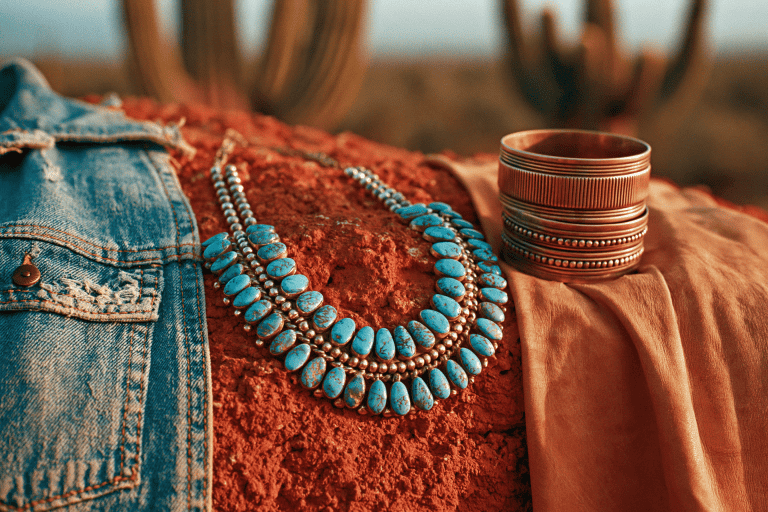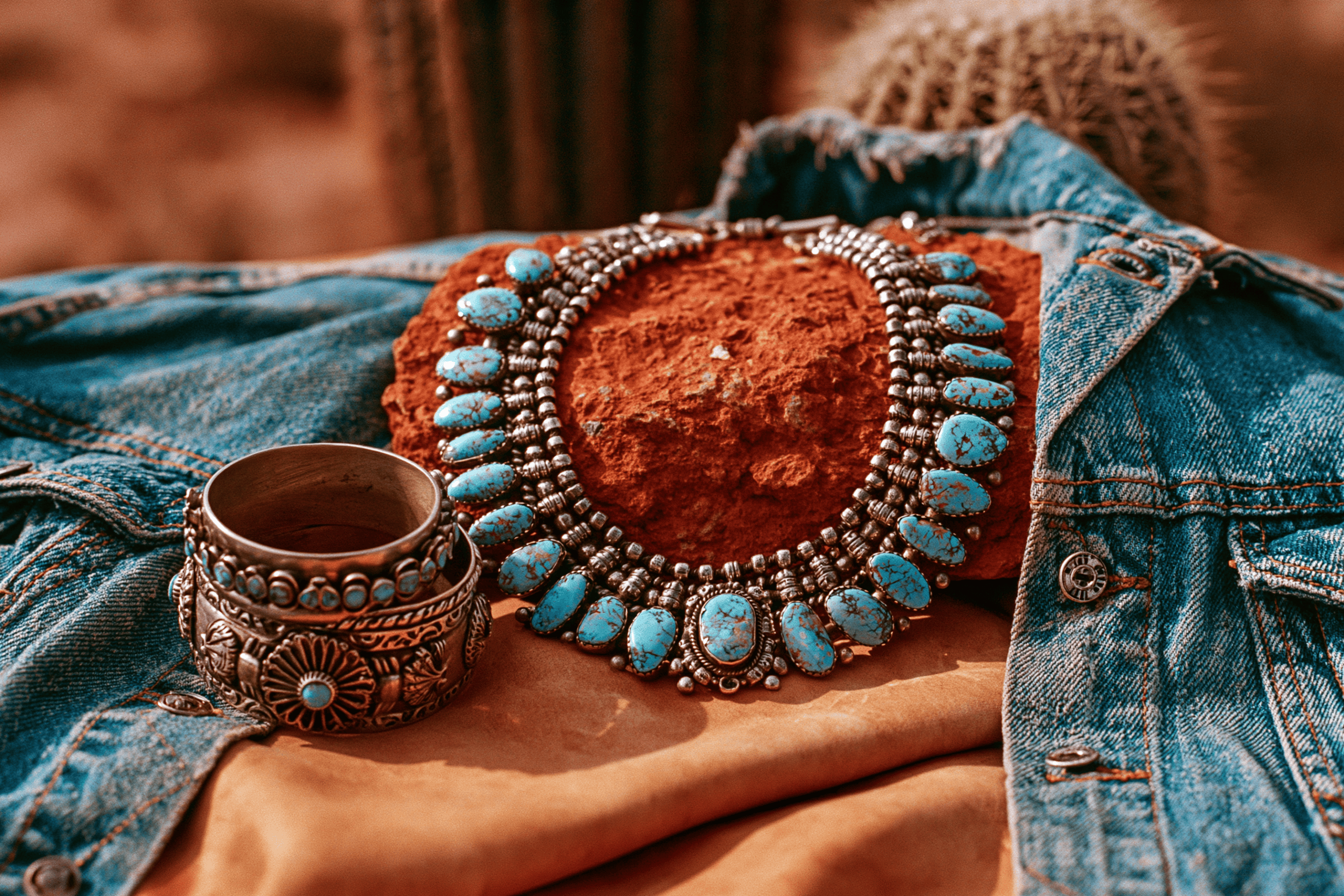
The Squash Blossom Necklace: A Crown of the Desert
If one piece says “Southwest” without a word, it is the squash blossom necklace — a great silver crescent hung with rows of blooming beads. It looks ancient and unmistakably American at once. Its real story is a journey across three continents.
Reading the necklace
Every squash blossom follows the same architecture: an inverted crescent centerpiece called the Naja, flanked on each side by a row of roughly six flower-shaped beads — the “blossoms.” Later, Zuni craftspeople added the intricate turquoise inlay many people picture today.
The crescent that crossed an ocean
The Naja is far older than the Southwest. Its crescent shape is said to trace back to the Middle East, where it was worn as a charm against the evil eye. The Moors carried it into Spain; Spanish conquistadors carried it to the Americas — often as a bridle ornament on their horses — and the Navajo adopted and transformed it. In Diné hands it became a symbol of protection and spiritual safeguarding.
What the blossoms mean
The “squash” blossoms likely began as Spanish pomegranate motifs — a European symbol of abundance — reinterpreted in silver. Together, crescent and blossom came to stand for fertility, abundance, and protection: a small harvest worn at the throat.
Why it endures
A squash blossom was worn as wealth and belonging, and it still reads that way — bold, balanced, impossible to ignore. It is proof that the best jewellery is never only beautiful; it means something. That is why a genuine vintage squash blossom remains one of the most collected pieces in American jewellery.
The story continues: how turquoise and silver became the soul of the Southwest, and the year Cher made the squash blossom famous.