The Secret Language of Flowers
In an age too polite to speak plainly, the Victorians let flowers do the talking. A carefully chosen posy could say what a lady never could aloud — remember me, I love you, forgive me — all in perfect, fragrant silence.
A code carried home from Constantinople
The craze has an unlikely origin. In 1718, the English aristocrat and poet Lady Mary Wortley Montagu wrote home from Constantinople describing a Turkish pastime called sélam, in which objects were exchanged to stand in for rhyming words. Montagu romanticised it into something grander — a secret floral language used to pass messages past watchful eyes. Whether or not she had it quite right, the idea enchanted Europe.
Why the Victorians fell for it
By the nineteenth century, floriography had bloomed into a full craze, complete with published dictionaries pairing each flower to a meaning. It suited the Victorians perfectly. Theirs was a reserved society where speaking your feelings outright was a social misstep — so a bouquet became a way to say the unsayable.
The grammar could be intricate. A red rose meant love; a yellow one, jealousy or friendship. Flowers offered upside-down reversed their meaning. Even the hand you presented them with could tilt a yes toward a no.
The little blue flower
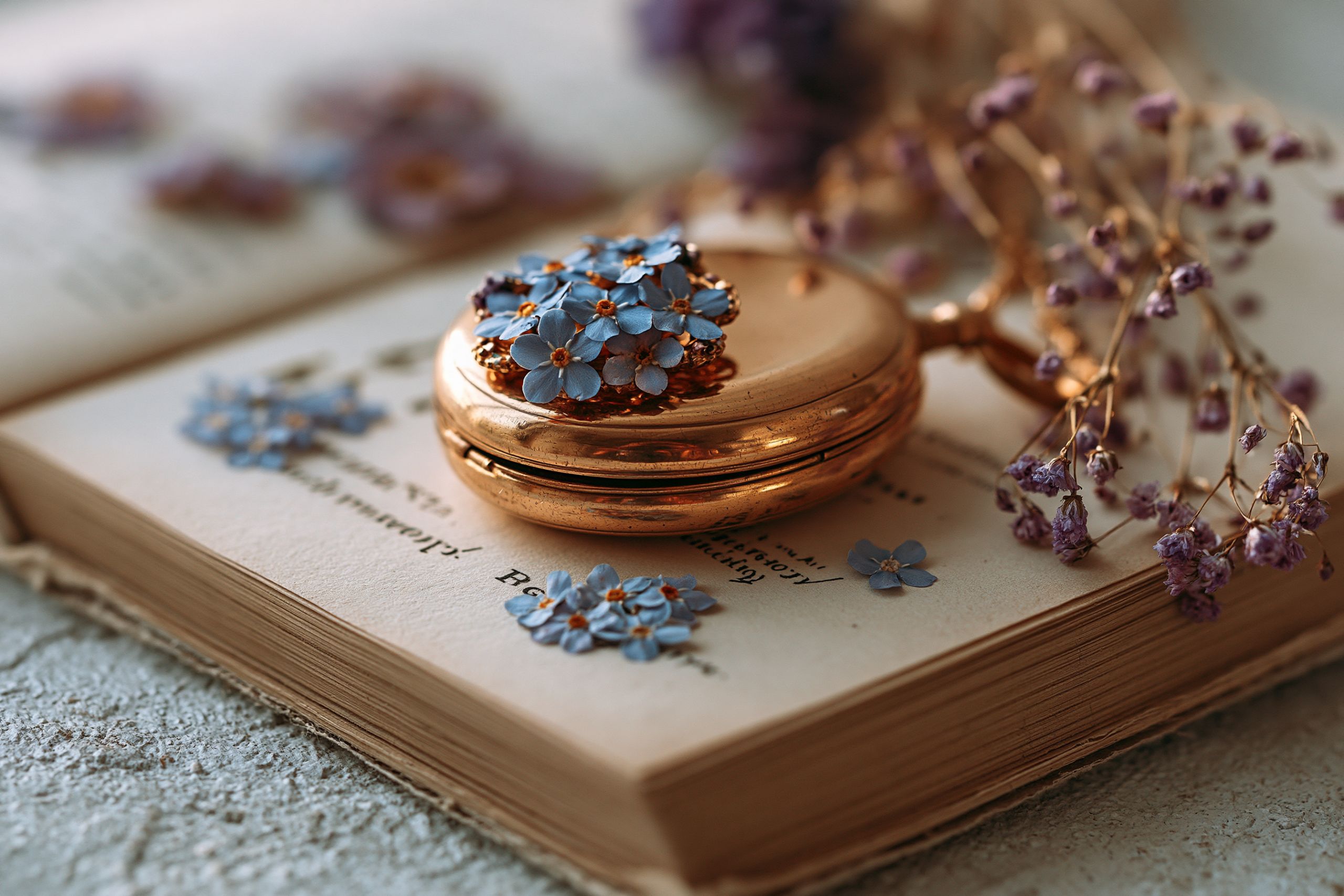
No bloom carried the message more tenderly than the forget-me-not. Its very name is a plea, drawn from a medieval German legend: a knight, gathering the small blue flowers by a river for his love, was swept away by the current and threw the posy to her with a last cry — Vergiss mein nicht, forget me not. Ever since, the flower has stood for remembrance and true, faithful love.
That is the quiet charm of floriography, and the reason it still moves us. It treats a flower — and a jewel worked in its image — as something that can hold a message, and carry it far longer than the bloom itself.
Sources: Wikipedia and Erica Weiner, on the language of flowers and Lady Mary Wortley Montagu; general references on Victorian floriography; German folklore, on the forget-me-not legend.
More secret languages: the serpent ring’s love story, and the story of birthstones.