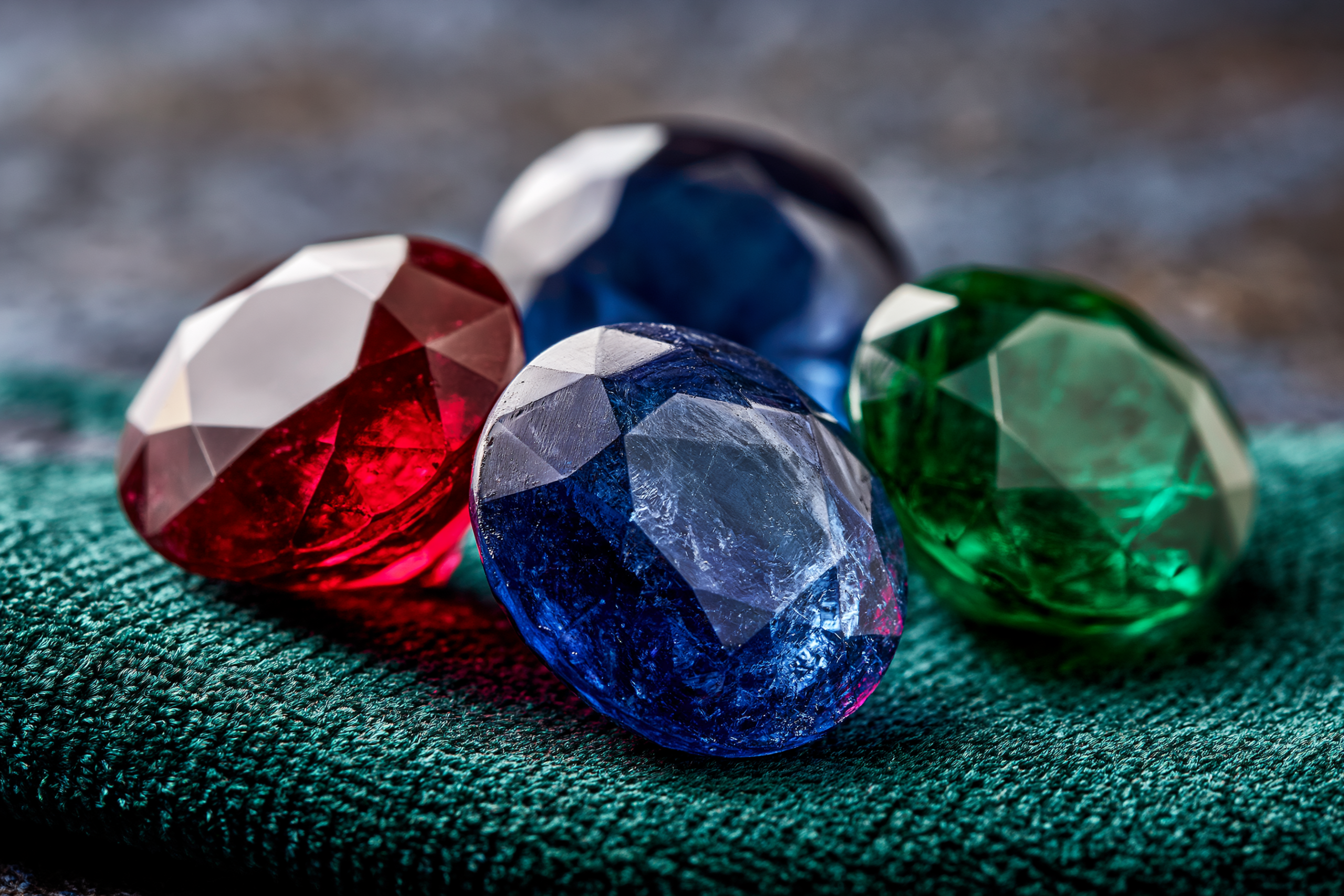
The Big Three: Ruby, Sapphire and Emerald
Long before the diamond ruled, colour ruled. Three gems have been treasured above almost all others for thousands of years — and here is the twist: two of them are, astonishingly, the very same mineral.
Two gems, one mineral
Ruby and sapphire are both corundum — crystalline aluminium oxide — and both sit at a formidable 9 on the Mohs scale, harder than anything on earth except diamond. The only difference is a whisper of trace elements. Red corundum, coloured by chromium, is ruby. Every other colour of corundum — blue, pink, yellow, green, violet, the rare peachy padparadscha — is a sapphire.
The reddest red
Ruby’s glory is its red, and the most coveted shade has a name of its own: “pigeon’s blood” — a pure, vivid red with a hint of blue, historically from the mines of Burma. It is chromium that lights that fire, the same element that, in a different host crystal, turns beryl into emerald.
Blue with a thousand faces
Sapphire is far more than blue, but blue is its legend. The most storied of all came from Kashmir — a velvety, cornflower blue so prized that, with the mines now essentially exhausted, a fine Kashmir sapphire is among the rarest gems on the market.
The garden inside the emerald
Emerald is a different mineral entirely — beryl, coloured green by chromium and vanadium. It is softer than corundum (7.5–8) and almost always carries fine internal inclusions the French poetically call the jardin, or garden. Far from flaws, they are a fingerprint of authenticity. The finest emeralds have long come from Colombia, from the legendary mines of Muzo and Chivor.
This is the pleasure of colour: a ruby, a sapphire, an emerald each say something a diamond cannot. Where a diamond is light, a coloured gem is mood — and choosing one is a little like choosing a word in your own private language.
Sources: International Gem Society and Wikipedia, on corundum, ruby and sapphire; GROMOV and HERMJ, on gemstone hardness and colour chemistry; Sotheby’s, on Kashmir sapphires; general references on Colombian emeralds (Muzo, Chivor).
Related reading: birthstones by month, and how quality is judged in any stone. Ruby, July’s own gem, gets a portrait of its own.